Short-sightedness: understanding the condition and choosing the right correction
Blurred vision at a distance, eye strain: short-sightedness is affecting more and more people. Here’s what you need to know and how to get the right glasses.
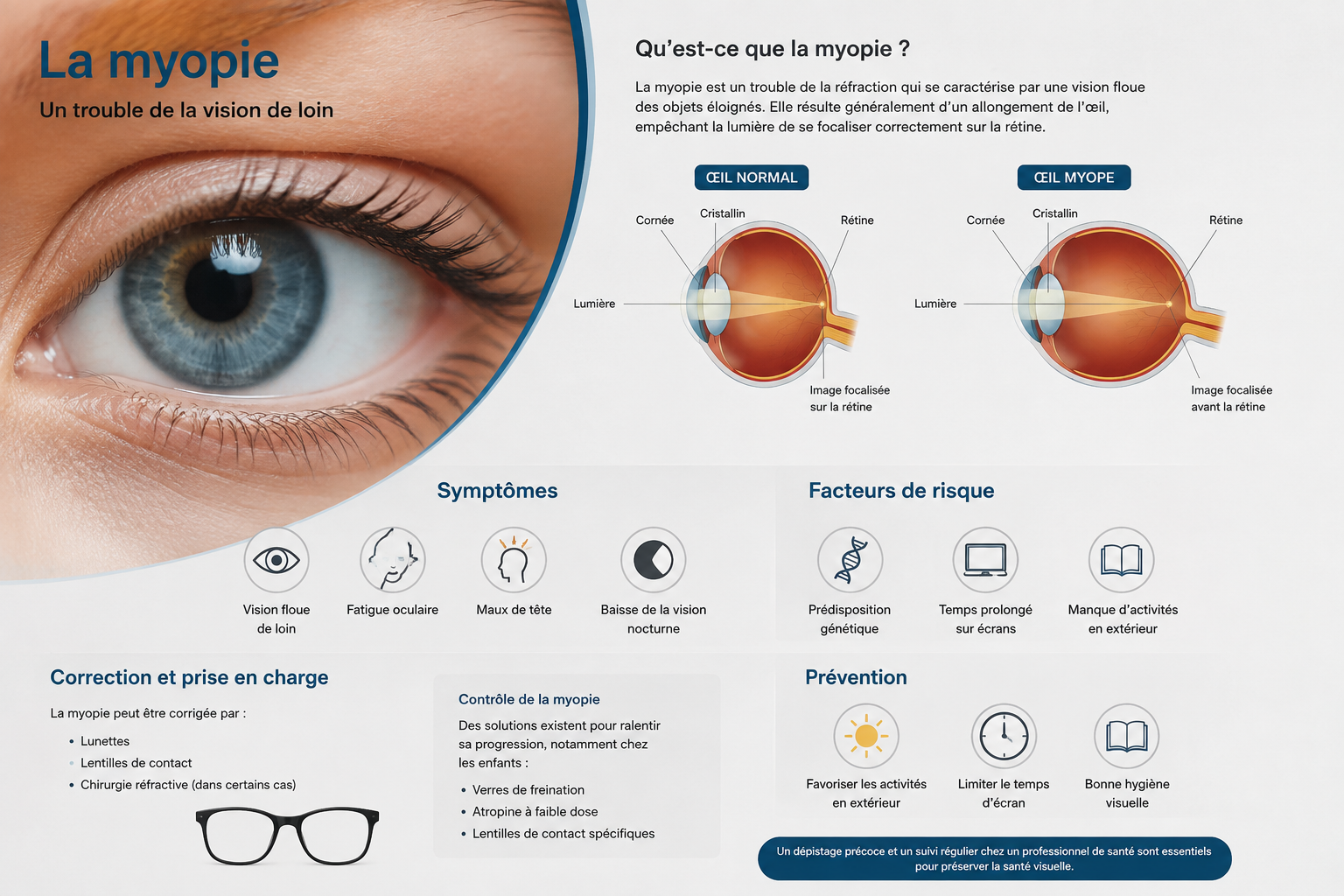
Short-sightedness is one of the most common vision problems we encounter in our shop. It causes blurred vision when looking at distant objects, whilst close-up vision generally remains clear. Here are a few pointers to help you better understand this condition and learn how to manage it effectively in everyday life.
What exactly is short-sightedness?
Optically speaking, short-sightedness occurs when the eye is slightly too long, or when its curvature is too pronounced. As a result, the image of a distant object is focused in front of the retina rather than on it. A short-sighted person therefore sees clearly up close but blurrily at a distance, with the severity varying depending on the degree of short-sightedness.
This condition most often develops during childhood or adolescence and can continue to progress until growth is complete. In adults, short-sightedness tends to stabilise, but it may vary slightly over the years, particularly in cases of significant eye strain or prolonged screen use.
Factors that may contribute to myopia
Several factors are regularly associated with the onset or progression of myopia, although they do not constitute a single or systematic cause:
- Family history: a child with one or both parents who are short-sighted is often at increased risk
- Time spent on prolonged near-vision activities, such as reading or screen use, particularly in children whose eyes are still developing
- Lack of time spent outdoors in natural light, a factor that is increasingly being studied in young children
- Rapid eye growth during certain periods of childhood and adolescence
These factors do not allow us to predict with certainty who will develop short-sightedness, but they partly explain why short-sightedness is now closely monitored, particularly in younger children. Regular eye check-ups from an early age remain the best way to detect any changes and adjust the prescription accordingly.
Warning signs
Certain signs are commonly reported by people who discover they have myopia:
- Difficulty reading road signs or bus numbers from a distance
- Needing to squint to see better at a distance
- Headaches at the end of the day, particularly after sustained visual activity
- Eye strain at the cinema or when driving at night
These symptoms are never a substitute for a professional diagnosis. If you recognise them, the best course of action is to consult an optician or an ophthalmologist to have your eyesight assessed.
How short-sightedness is corrected in-store
As opticians, our role is first to accurately analyse the degree of short-sightedness in each eye, then to suggest the corrective solution best suited to the person’s lifestyle. Several options are available:
Prescription glasses remain the most common and straightforward solution. They are suitable for all ages and allow you to express your personal style, with frames designed for both everyday wear and to add a touch of flair to an outfit. Our collections of women’s prescription glasses and men’s prescription glasses cater to a range of vision correction needs, featuring frames from brands such as Saint Laurent, Miu Miu and Ray-Ban.
Contact lenses offer greater freedom of movement, particularly for sport or activities where glasses are a hindrance. Choosing the right lenses requires appropriate guidance, which we provide through our contact lens service, offering personalised support to help you find the right type of lens based on the shape of your eye and your lifestyle.
In all cases, a properly fitted correction requires an accurate eye test. That is why we recommend taking the time to book an appointment in-store or with an ophthalmologist, rather than relying solely on an old prescription.
Myopia-control lenses for children
In children and teenagers, short-sightedness often tends to progress as they grow. To support this development, there are now specialised lenses, known as myopia control lenses, designed to influence the way the image forms on the retina and thus slow the progression of myopia.
These lenses are worn like standard glasses, with a correction tailored to the child’s eyesight, but their optical design differs from that of traditional corrective lenses. They are always fitted in consultation with an eye care professional, who assesses the progression of myopia and determines whether this solution is appropriate for the child’s individual circumstances.
In-store, we support families through this process by explaining how these lenses work and ensuring regular monitoring of the prescription as the child grows. This is a topic we are happy to discuss during a dedicated appointment, particularly when a child’s short-sightedness is progressing rapidly.
Living with short-sightedness day to day
Properly corrected short-sightedness needn’t hold you back. Many of our short-sighted customers wear their glasses as a real fashion accessory, sometimes owning several pairs for different occasions: a simple frame for work, a bolder one for the weekend. It’s also a chance to update your prescription regularly whilst discovering the latest arrivals in-store.
When it comes to sunglasses, those with short-sightedness should not neglect UV protection. It’s perfectly possible to have prescription lenses fitted to sunglasses, so you can enjoy clear, comfortable vision even when outdoors.
Get an eye test with a professional
If you think you might be short-sighted, or if you feel your current prescription is no longer suitable, the best course of action is to have a full eye test. Our team of qualified opticians in Lyon’s 2nd arrondissement are available by appointment to assess your eyesight and guide you towards the most suitable solution, whether that’s glasses, contact lenses, or a combination of both, depending on your lifestyle.
Please feel free to consult our practical guides to find out more about specific eye-related topics, or pop in to chat with us in-store on Lyon’s Presqu’île. Properly corrected vision means, above all, greater comfort in everyday life – and sometimes a real aesthetic pleasure too.