Choosing your glasses doesn't stop at the frame. Corrective lenses play a central role in your visual comfort, your adaptation and your everyday wellbeing. A poorly suited lens can cause fatigue, discomfort or headaches, even with a beautiful frame.
At Olivia Balm, our opticians advise you online or in our shop in Lyon, and support every customer in choosing lenses suited to their correction, their lifestyle and their real-life uses. This guide helps you understand the essential criteria for making the right choice.
Understanding your visual correction
Before talking about materials or coatings, it is essential to start from your prescription. Depending on your needs, lenses can correct:
- ✔️short-sightedness (blurred distance vision)
- ✔️long-sightedness (blurred near vision or visual fatigue)
- ✔️astigmatism (distorted vision)
- ✔️presbyopia (difficulty seeing up close with age)
👉 Each correction requires specifically designed lenses, both in optical terms and in terms of thickness or geometry.
Did you know? There can be several billion possible combinations for a single lens range.
Single-vision, varifocal or specific lenses: which to choose?
Single-vision lenses
They correct a single distance: distance vision or near vision. They are generally recommended for:
- ✔️young wearers
- ✔️simple corrections
- ✔️a specific use (reading, screen)
Varifocal lenses
They let you see clearly at every distance without changing glasses. They are particularly suited to:
- ✔️presbyopia onwards
- ✔️everyday use
- ✔️those who want an attractive, practical solution
See our full guide: Varifocal lenses — who they're for, benefits and price →
Specific lenses
Depending on your daily life, some lenses are designed for:
- ✔️screen work
- ✔️driving
- ✔️prolonged reading
- ✔️outdoor activities
A good choice always depends on your real lifestyle, not just your age.
The thinning index: visual comfort and aesthetics
The higher the index, the thinner the lens for an equivalent correction. The stronger the correction, the higher the recommended index, in order to limit thickness, weight and visual distortion.
In practice:
- Standard index (1.5)
✔️Light corrections ✔️Occasional use or second pair
- Intermediate index (1.6)
✔️Medium corrections ✔️A good balance between thinness, comfort and budget
- High index (1.67 / 1.74)
✔️Strong corrections ✔️Improved aesthetics, thinner and lighter lenses
👉 A thinned lens is often more attractive and comfortable, especially on thin or metal frames. However, it is not always essential: the choice depends on your correction, the frame and your everyday use.
🔗 Read also: Are thinned lenses really necessary?
Coatings: a real plus day to day
Surface coatings are not just options: they play a key role in visual comfort, vision quality and the durability of your glasses.
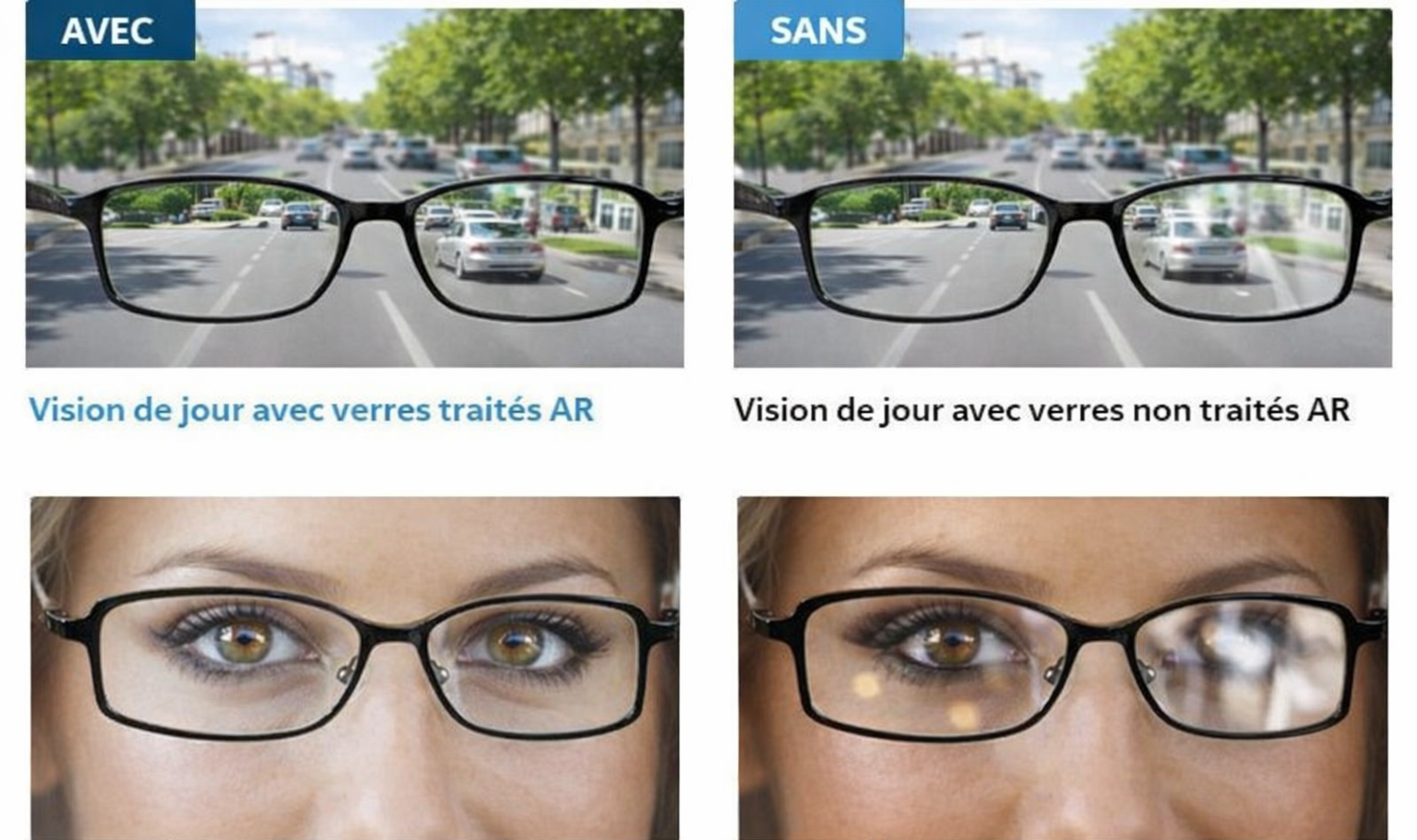
Anti-reflective coating: essential for visual comfort
Anti-reflective coating is now indispensable on prescription glasses. It helps to:
- ✔️ Greatly reduce stray reflections
- ✔️ Improve sharpness and contrast
- ✔️ Limit visual fatigue
- ✔️ Make night driving easier
- ✔️ Improve comfort on screens (computer, phone)
👉 It also improves aesthetics: your eyes stay visible, with no annoying reflections on the lenses.
🔗 See our FAQ: Anti-reflective coating: is it really useful?
Blue light protection: to choose according to your use
Lenses with partial blue light filtering are designed for people heavily exposed to screens. They can:
- ✔️ Reduce visual fatigue linked to prolonged screen work
- ✔️ Provide greater comfort at the end of the day
- ✔️ Limit digital glare
⚠️ A nuance: blue light is not only harmful, it is also necessary for the body clock. Only blue-violet light is harmful.
Did you know? Turquoise light is essential for sleep quality and wellbeing in general.
👉 This coating is relevant according to your actual screen time, not as a fashion trend.
🔗 FAQ: Blue light: information or marketing?
Hardened and hydrophobic coatings: for more resistant lenses
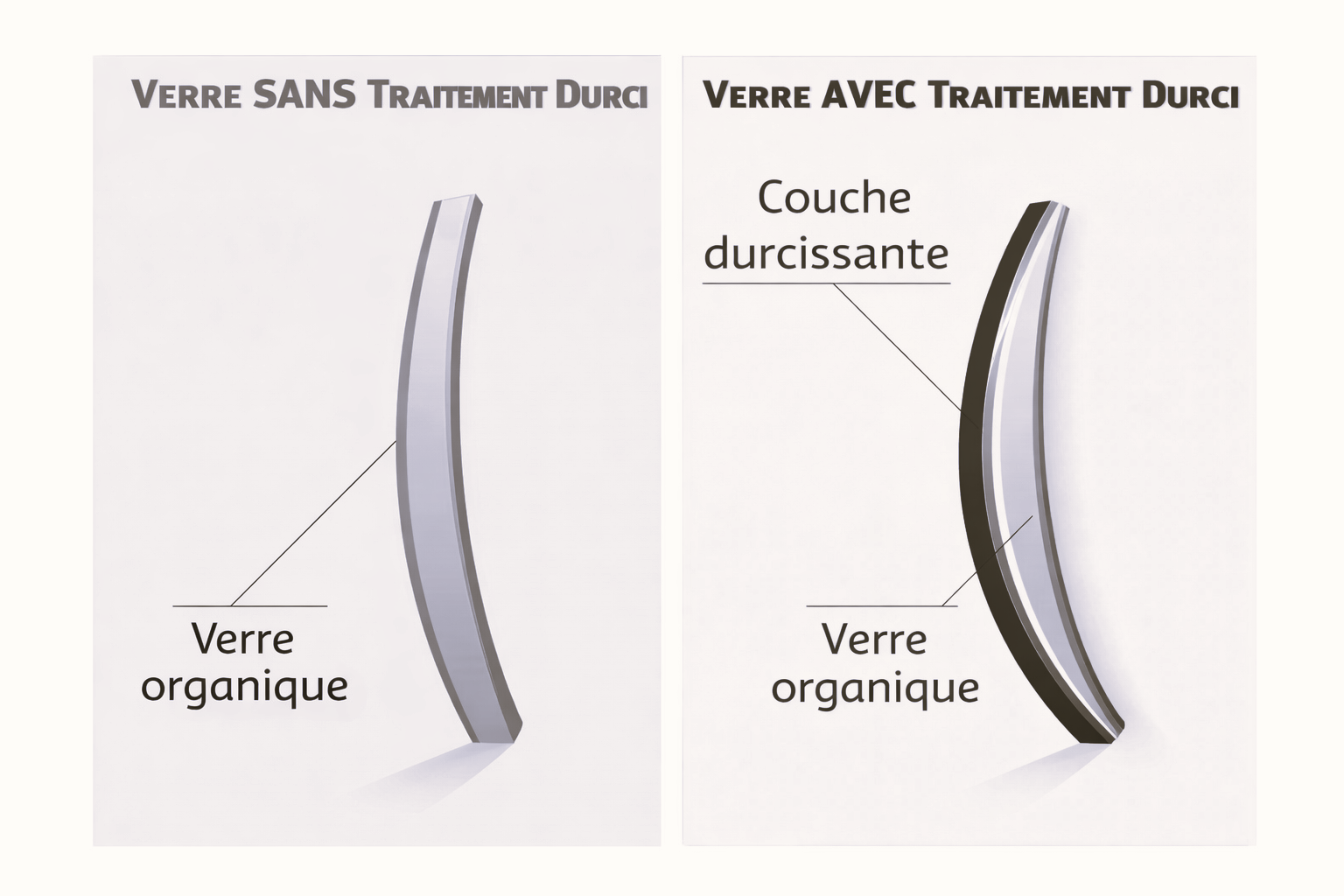
The hardened coating (often wrongly called "scratch-resistant")
It increases the lens's resistance to micro-scratches and everyday wear.
⚠️ Beware of misleading language: there is no such thing as a completely scratch-proof lens. The correct term is hardened (durci), meaning a lens whose surface is reinforced to reduce the risk of scratches, not to prevent them entirely.
👉 Be wary of overly ambitious commercial promises.
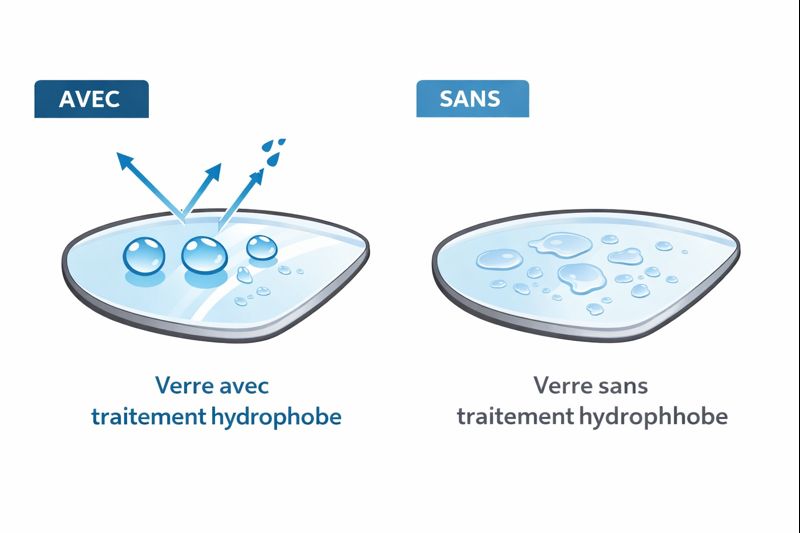
The hydrophobic and oleophobic coating
This coating makes daily life easier:
- ✔️ Water slides off the lens
- ✔️ Fingerprints stick less
- ✔️ Cleaning is faster and more effective
- ✔️ Better vision in the rain or in damp conditions
👉 Indispensable for everyday use, especially outdoors or for demanding wearers.
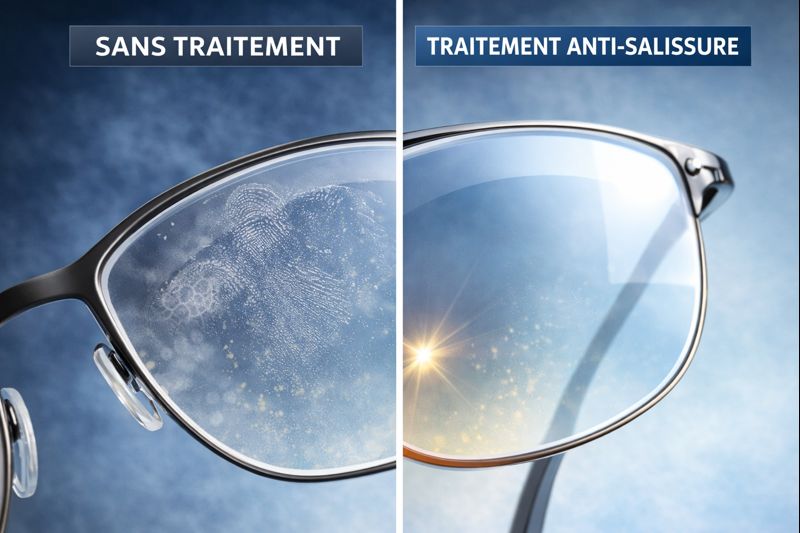
Other optical lens coatings worth knowing about
Oleophobic / anti-smudge coating
Often combined with the hydrophobic coating, the oleophobic coating prevents greasy substances (sebum, make-up, fingerprints) from adhering to the lens surface.
Benefits:
- ✔️ Fewer fingerprints
- ✔️ Cleaner lenses for longer
- ✔️ Easier cleaning
- ✔️ Everyday aesthetic comfort
👉 Particularly recommended for wearers who handle their glasses often, who work in an urban or dusty environment, or who are sensitive to the look of their lenses.
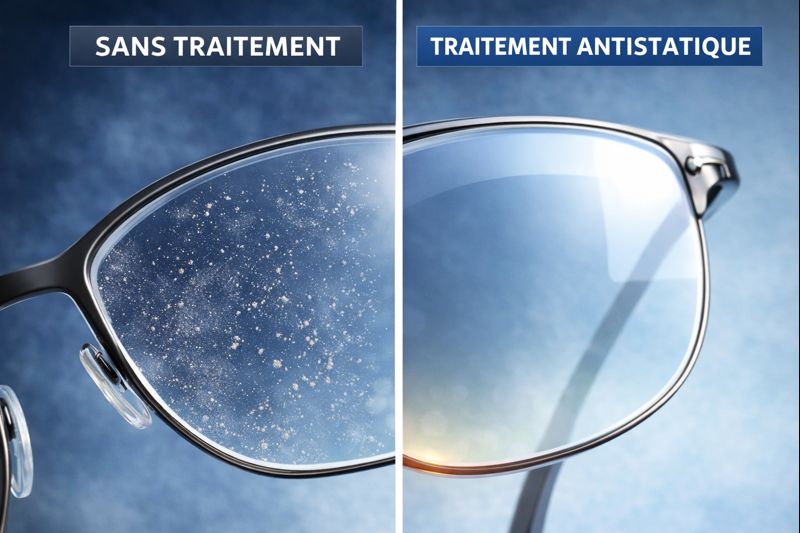
Anti-static coating
The anti-static coating limits the build-up of static electricity on the lens surface.
Why is it useful?
- ✔️ Reduces dust adhesion
- ✔️ Lenses stay clean for longer
- ✔️ Less daily cleaning
👉 Often included in premium coatings, it is much appreciated in dry or air-conditioned environments.
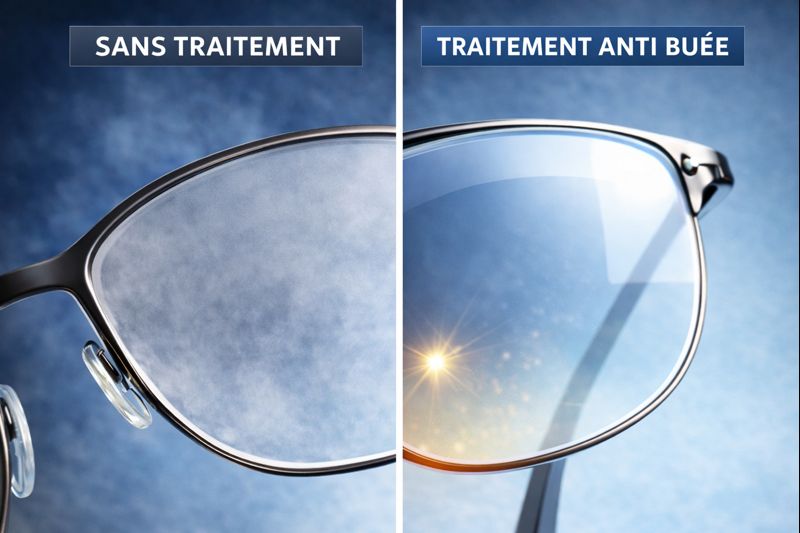
Anti-fog coating (specific use)
The anti-fog coating prevents condensation from forming on the lens surface during temperature changes.
Recommended for:
- ✔️ Wearing a mask
- ✔️ Medical professions
- ✔️ Cold or damp environments
- ✔️ Sport and outdoor activities
⚠️ Note: some anti-fog coatings are temporary (to be reactivated). Others are built into the lens but require specific care.
👉 To be advised on a case-by-case basis, according to the user's environment.
UV protection: essential, even without sun
All quality lenses should include 100% UV protection (UV400). It helps to:
- ✔️ Protect the eyes from premature ageing
- ✔️ Reduce the risk of eye conditions
- ✔️ Preserve visual comfort in the long term
👉 Beware: a clear lens with no UV protection can be more dangerous than no lens at all, because the dilated pupil lets in more UV. UV protection is essential on all lenses, including clear ones.
Photochromic lenses: comfortable light indoors and outdoors
Photochromic lenses darken automatically depending on UV brightness.
Benefits:
- ✔️ A single pair for indoors and outdoors
- ✔️ Constant visual comfort
- ✔️ Permanent UV protection
- ✔️ Ideal for people sensitive to light
⚠️ A limitation to be aware of: the darkening is only partial in a car, because the windscreen filters out UV.
👉 A solution that is very popular for versatile, everyday use.
Polarised coating (sun lenses)
The polarised coating is reserved for sun lenses. It helps to:
- ✔️ Remove annoying reflections (water, snow, road)
- ✔️ Improve contrast
- ✔️ Reduce glare
- ✔️ Provide more restful vision
👉 Recommended for driving, water sports, the mountains or strong brightness.
In summary: a complete overview of optical coatings
- ✔️ Anti-reflective: indispensable
- ✔️ Hardened: increased resistance
- ✔️ Hydrophobic / oleophobic: easier care
- ✔️ Anti-static: less dust
- ✔️ Anti-fog: specific use
- ✔️ UV protection: mandatory
- ✔️ Blue light: according to screen use
- ✔️ Photochromic: comfort indoors / outdoors
- ✔️ Polarised: high-end sun
Your optician's advice: a good lens is not the one that stacks up every coating, but the one that genuinely matches your use, your correction and your lifestyle.
Adapting the lenses to the chosen frame
Not all lenses suit all frames. A rimless, thin, oversize or very wraparound frame requires precise lens adaptation to guarantee stability, aesthetics and wearing comfort.
At Olivia Balm, every frame + lens combination is studied to preserve the balance of the chosen model.
Common mistakes to avoid
When choosing corrective lenses, certain mistakes are common:
- ✔️choosing solely on price
- ✔️accepting a lens unsuited to your use
- ✔️underestimating the importance of coatings
- ✔️neglecting the adaptation to the frame
👉 A well-chosen lens makes itself noticed… by the absence of any discomfort.
Corrective lenses online: is it reliable?
Yes, provided you are well supported. At Olivia Balm:
- ✔️the necessary information is clearly explained
- ✔️the lens selection is guided
- ✔️you can choose:
- - a complete adaptation to your vision
- - or a reservation in the shop for personalised support
The Olivia Balm support
As opticians in Lyon, online as well as in the shop, we have chosen a demanding approach to support:
- ✔️rigorous lens selection (Essilor, Nikon)
- ✔️advice tailored to each customer
- ✔️consistency between correction, frame and use
Our goal: to offer you glasses that are as pleasant to wear as they are beautiful to look at.
Going further
How to choose glasses to suit your face shape → Varifocal lenses: who they're for, benefits and price → How to read my glasses prescription → How to care for your glasses →
Need help choosing your lenses?
You can order online or book an appointment in our shop in Lyon for bespoke support.
See our women's prescription glasses → See our men's prescription glasses → Book an appointment in the shop →